
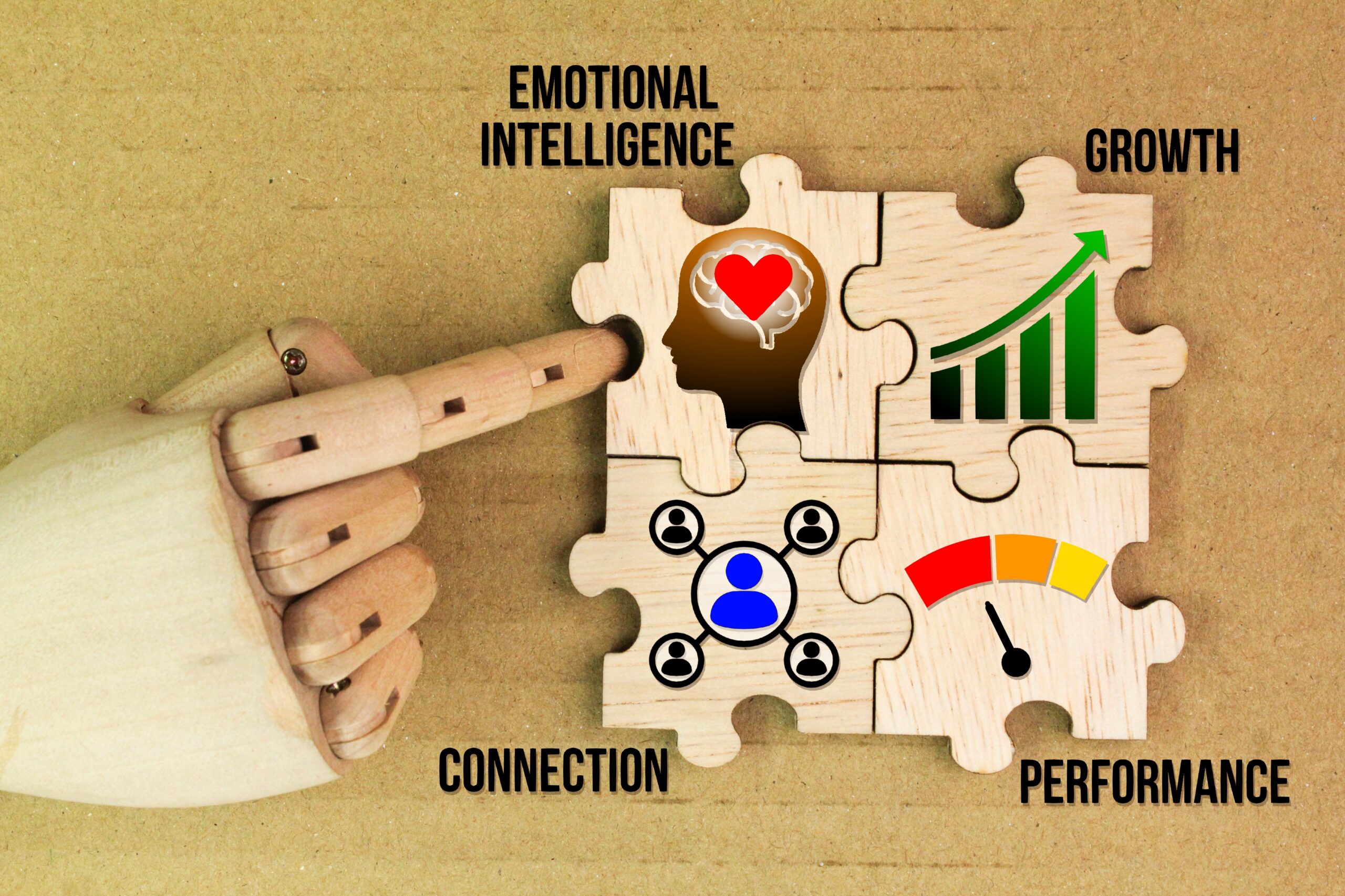
Emotional intelligence (EI) is the capacity to notice, understand, use, and regulate emotion in oneself and in others so that thinking, relationships, and decisions stay accurate under pressure. It is not simply being “nice,” highly sensitive, or endlessly expressive. It is a set of observable skills: recognizing feeling as it arises, naming it with enough precision to be useful, distinguishing one’s own state from another person’s, and choosing a response that fits the situation rather than discharging whatever is most intense.
Why Mental Health Professionals Should Learn EI
Two complementary frameworks are useful in clinical work. The ability model associated with Mayer and Salovey treats EI as four linked skills: perceiving emotion (in faces, voice, posture, and one’s own body), using emotion to support attention and problem-solving, understanding how feelings arise and change, and managing emotion in self and others. Goleman’s popular model organizes similar territory into self-awareness, self-regulation, motivation, empathy, and social skill. For mental health professionals, the practical core is the same: accurate inner data, regulated presence, and interpersonal attunement that does not collapse into fusion or withdrawal.
These skills matter because psychotherapy and counseling are emotion-saturated work. Clients rarely present only ideas; they present fear, shame, grief, rage, numbness, and hope, often in mixed or contradictory form. A clinician with weak EI may miss the feeling that is actually organizing the session, mistake a client’s anxiety for hostility, or treat a surge of their own irritation as “clinical intuition.” Assessment then drifts. Risk can be under- or overestimated. Formulations become stories about the client that are partly stories about the therapist’s unexamined state.
EI also protects the alliance. Empathy is not automatic warmth. It is the disciplined act of tracking another person’s inner world while remaining a separate person who can think. That balance allows the clinician to stay close enough to be trusted and boundaried enough to be useful. When ruptures occur—and they will—emotionally intelligent practitioners can notice the break, own their contribution without collapsing into self-attack, and repair. Repair is one of the strongest predictors of continued engagement; it depends on self-awareness and regulation more than on technique.
Countertransference is another reason the skill set is not optional. Clients evoke responses: rescue, boredom, moral judgment, erotic pull, helplessness, grandiosity. EI does not eliminate those reactions. It makes them visible soon enough that they can be used as information rather than acted out as extra sessions, premature advice, avoidance of hard topics, or punitive silence. Supervision is more productive when the clinician can describe an inner reaction instead of only reporting what the client “did.”
The work also loads the clinician’s nervous system. Repeated exposure to trauma narratives, suicidality, family conflict, and systemic injustice produces vicarious strain. Practitioners who cannot recognize early signs of depletion — irritability, flattening, cynicism, somatic tightness — are more likely to drift into burnout or boundary erosion. EI supports earlier self-care and clearer limits, which are ethical duties, not private luxuries.
Finally, contemporary practice is interprofessional. Coordinating with physicians, dietitians, schools, and families requires reading rooms as well as individuals: when a colleague is defensive, when a family is speaking from fear rather than fact, when one’s own certainty is covering discomfort. Emotionally intelligent communication reduces preventable friction and keeps the client’s safety, rather than professional pride, at the center of the exchange.
Developing EI is therefore not an enrichment activity adjacent to “real” clinical skill. It is part of diagnostic accuracy, alliance, ethics, and endurance. Training, supervision, mindfulness of bodily cues, and honest review of sessions are how the capacity is built. The aim is not perfect composure. It is a reliable enough relationship to one’s own feeling that the client’s feeling can be met without being distorted.
Want to learn more?
Developing Emotional Intelligence is a 4-hour online video-based continuing education (CE) course that explores what emotional intelligence is, why it’s important, and how to develop it.
Emotional intelligence is the ability to monitor one’s own and other people’s emotions, to discriminate between different emotions and label them appropriately, and to use emotional information to guide thinking and behavior. Developing emotional intelligence leads to greater success in work performance and engagement, decreased likelihood of burnout, and general happiness and well-being. This course explores the concept of emotional intelligence (EI), its significance, measurement methods, and importantly, practical strategies to develop the four core domains of EI:
Part 1: Developing Self-Awareness
Part 1 includes discussion of popular models of EI, how it is measured, and methods for developing self-awareness. Dr. Wiederman discusses inherent difficulties in assessing EI and uses the most popular, four-domain model to structure the presentation of methods for developing EI. The initial focus is on understanding emotional intelligence and then delving into actionable ways to cultivate it, starting with self-awareness.
Part 2: Developing Emotional Self-Management
Part 2 focuses on the second and third domains in the four-domain model of EI: emotional self-regulation and interpersonal awareness. Dr. Wiederman discusses several methods for developing emotional self-regulation in the short term (e.g., mindfulness practice in everyday life, decentering) as well as methods for more enduring change (e.g., cognitive restructuring, values clarification). To develop greater interpersonal awareness Dr. Wiederman describes 10 different inherent cognitive biases that are universal and discusses how each influences our perceptions of others.
Part 3: Developing Interpersonal Awareness
Part 3 begins with continuation of developing greater understanding of others by testing the participant’s ability to recognize facial expressions and body language. Then the fourth domain of emotional intelligence – relationship management– is addressed. Specifically, Dr. Wiederman focuses on the subdomain of interpersonal influence by discussing four types of trust and how to develop each with others.
Part 4: Developing Relationship Management Skills
Part 4 begins with continuation of focus on interpersonal influence, including leveraging the Big 4 universal human motivations and applying 11 classic techniques of persuasion. Dr. Wiederman addresses the final subdomains of relationship management: Communication and Resolution of Conflict. In both areas models are presented to help participants communicate in ways that reduce the likelihood of misunderstanding and disappointment, and structure difficult conversations to facilitate resolution of conflict.
Case examples and applications are included throughout to assist the practitioner in deepening their understanding of emotional intelligence, expanding their self-awareness, strengthening emotional self-control, developing understanding for other people, and becoming more skilled at communicating, persuading, and resolving conflict. A transcript is provided for each course video.
Course #40-58 | 2026 | 25 posttest questions | Mobile-Friendly
CE Information
Professional Development Resources is approved by the American Psychological Association (APA) to sponsor continuing education for psychologists. Professional Development Resources maintains responsibility for all programs and content. Professional Development Resources is also approved by the National Board of Certified Counselors (NBCC ACEP #5590); the Association of Social Work Boards (ASWB #1046, ACE Program); the Continuing Education Board of the American Speech-Language-Hearing Association (ASHA #AAUM); the American Occupational Therapy Association (AOTA #3159); the Commission on Dietetic Registration (CDR Prior Approval Program); the Alabama State Board of Occupational Therapy; the Arizona Board of Behavioral Health Examiners, Board of Occupational Therapy Examiners, and Board of Psychologist Examiners; the Arkansas Board of Examiners in Speech-Language Pathology and Audiology and State Medical Board for Occupational Therapy; the Florida Board of Clinical Social Work, Marriage & Family Therapy, and Mental Health Counseling, Board of Psychology, Office of School Psychology, Board of Speech-Language Pathology & Audiology, Board of Occupational Therapy, and Dietetics and Nutrition Practice Council; the Georgia Board of Examiners of Licensed Dietitians and Licensed Nutritionists, Board of Professional Counselors, Social Workers, and MFTs, State Board of Examiners of Psychologists, and State Board of Occupational Therapy; the Kansas Behavioral Sciences Regulatory Board for Marriage & Family Therapy, Professional Counseling, Psychology, and Social Work, and Board of Healing Arts for Occupational Therapy; the Louisiana State Board of Medical Examiners for Occupational Therapy; the Michigan Board of Occupational Therapy, Board of Psychology, Board of Speech-Language Pathology, and Board of Social Work; the Mississippi State Board of Examiners for Licensed Professional Counselors, the Bureau of Professional Licensure for Occupational Therapists, and Dietitians; the New Hampshire Board of Licensed Dietitians, Board of Mental Health Practice, Board of Psychologists, and Occupational Therapy Governing Board; the New York State Education Department’s State Board for Psychology (#PSY-0145), State Board for Mental Health Practitioners for licensed mental health counselors (#MHC-0135) and marriage and family therapists (#MFT-0100), and the State Board for Social Workers (#SW-0664); the North Carolina Psychology Board; the North Dakota Board of Social Work Examiners, State Board of Occupational Practice, and State Board of Psychologist Examiners; the Ohio Counselor, Social Worker, and Family Therapist Board and Speech and Hearing Professionals Board; the Oklahoma Board of Medical Licensure and Supervision for Occupational Therapy; the South Carolina Board of Professional Counselors and Marriage & Family Therapists (#193), Board of Examiners in Psychology, Board of Examiners in Speech-Language Pathology and Audiology, Board of Occupational Therapy, and Board of Social Work Examiners; the Tennessee Board of Examiners of Psychology, Board for Licensed Professional Counselors, Licensed Marital and Family Therapists, and Licensed Clinical Pastoral Therapists, Board of Occupational Therapy, and Board of Social Workers; the Texas State Board of Examiners of Marriage and Family Therapists (#114), State Board of Social Worker Examiners (#5678), State Board of Examiners of Professional Counselors, and State Board of Examiners of Psychologists; the West Virginia Board of Examiners in Counseling and Board of Social Work; the Wyoming Board of Psychology; and is CE Broker compliant (#50-1635 – completions are reported within 24 hours).

PDR offers over 100 accredited online CE courses for healthcare professionals.
Target Audience: Psychologists, School Psychologists, Counselors, Social Workers, Marriage & Family Therapists (MFTs), Speech-Language Pathologists (SLPs), Occupational Therapists (OTs), Registered Dietitian Nutritionists (RDNs), and Teachers
Enjoy 20% off all online continuing education (CE/CEU) courses @pdresources.org! Click here for details.